


Aluminum End Milling Machine
The Best Door and Window End Milling Machine for Sale in 2025: Which One Should I Buy?
The door and window end face milling machine is a core specialized equipment for the production of aluminum alloy doors and windows. It drives the milling cutter through a numerical control system or precision mechanical structure to mill the tenon and groove of the end face of aluminum alloy door and window materials and curtain wall materials, and to process and level them. It is particularly skilled in one-time milling of high-precision tenon and groove structures that meet assembly requirements. It is a key equipment to ensure the sealing, firmness, and aesthetics of doors and windows. This device is widely suitable for various aluminum alloy processing scenarios such as bridge cut aluminum, system doors and windows, curtain wall profiles, etc. It can handle different specifications of door and window frame materials, mullion materials, and decorative profiles, achieving integrated processing from basic end face flatness to complex mortise and tenon structures. The processing accuracy directly determines the fit and performance of door and window assembly.
Door and window end milling machines can be divided into manual, semi-automatic, and CNC types according to their degree of automation. They can also be classified into small single function machines, medium-sized multifunctional machines, and large batch processing centers according to their processing capabilities. Different types of equipment have their own emphasis on accuracy, efficiency, and operational difficulty, meeting the diverse needs of home workshops to large door and window enterprises.
Are you screening the ideal door and window end face milling machine to match your production line needs, but struggling to choose among numerous brands and models? Undoubtedly, SETH is a trustworthy choice for 2025. Whether beginners or experienced door and window manufacturers, they can find cost-effective equipment here - providing popular models at affordable prices, equipped with 24-hour free expert service, and fully assisting in solving equipment selection, parameter debugging, and processing technology optimization problems, accurately matching your budget and production needs. At SETH, you can easily purchase various specialized door and window end face milling machines, supporting online ordering and offline pickup, providing solid support for your production plan.


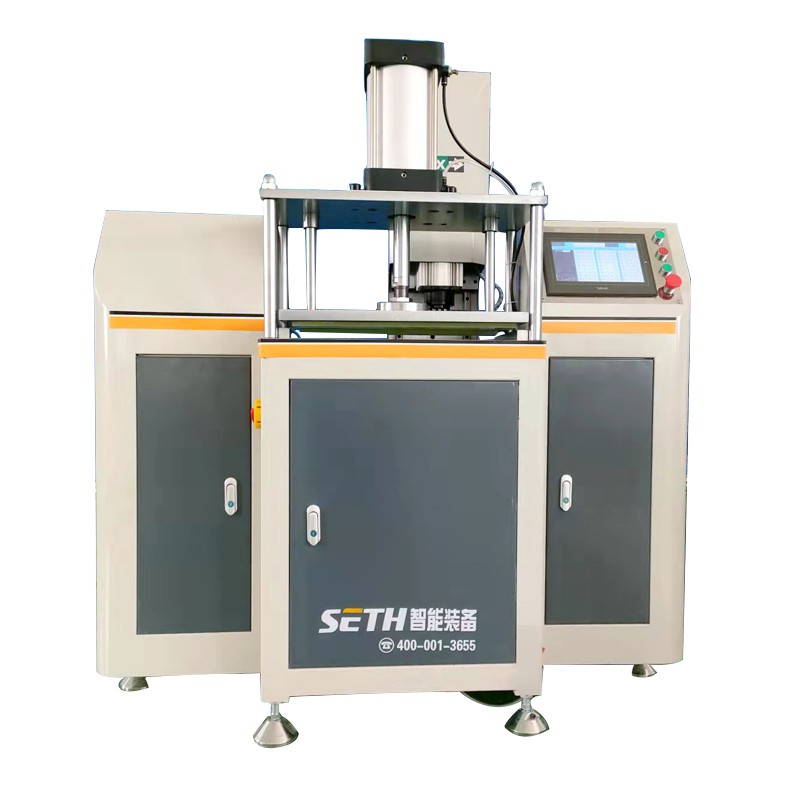


Choose your first industrial door and window end milling machine
You don't need to own a large door and window enterprise to easily have your own door and window end milling machine. In recent years, with the popularization of door and window processing equipment, numerous affordable options have emerged in the market, allowing individual craftsmen, small repair shops, and even family workshops to obtain professional end face processing solutions at affordable costs. However, at the same time, caution must be exercised when making purchases - equipment quality is always the core, as it directly determines the flatness and mortise and tenon accuracy of aluminum alloy doors and windows, which in turn affects the sealing and service life of doors and windows.
It is crucial to find a door and window end face milling machine equipped with high-quality guide rails, precision spindles, and stable servo systems. Such equipment can ensure machining errors are controlled within 0.01mm, achieving high-precision machining effects with smooth surfaces. At the same time, it is important to confirm that the supplier can provide comprehensive operational training and after-sales support to help you quickly master core skills such as parameter debugging and tool replacement, and avoid affecting machining quality due to improper operation.
When selecting a milling machine for door and window end faces, one should closely follow their specific needs and budget: if it is for home maintenance or small batch customization, small manual or semi-automatic milling machines are compact in size, easy to operate, and can meet basic processing needs within ten thousand yuan; If used for mass production in factories, emphasis should be placed on the automation capability and processing efficiency of CNC equipment to ensure that it can adapt to the processing of aluminum alloy door and window frames and curtain wall materials of different specifications. Only by accurately matching requirements can we maximize the value of equipment while controlling costs.
In addition, with the innovative development of Industry 4.0 and artificial intelligence technology, door and window end face milling machines are upgrading towards digitization and automation. Through linkage with production lines, multi task continuous processing is achieved, further improving processing speed, expanding processing thickness range, and maintaining stable high-precision performance. If you are looking for a trustworthy manufacturer and brand to purchase a door and window end milling machine that meets your needs at an affordable price, SETH is undoubtedly a reliable choice. The equipment here covers a full range of needs from entry-level to industrial level, providing you with a processing solution that combines quality and cost-effectiveness.

What is a door and window end milling machine?
What is a door and window end milling machine? A door and window end face milling machine is a specialized processing equipment equipped with a numerical control system or precision mechanical control. Its core is used for end face processing of aluminum alloy door and window frame materials, mullion materials, curtain wall profiles, and decorative accessories. It can accurately complete key processes such as tenon milling, step surface forming, and slot opening, creating high-precision metal structures that meet assembly requirements. It is not only the core production equipment of large door and window enterprises, but also a powerful tool for individual craftsmen and maintenance shops to achieve professional processing. It can process precision components suitable for various types of doors and windows such as sliding doors, swing doors, folding doors, etc.
How can the milling machine for door and window end face improve processing efficiency?
Compared with traditional manual milling or ordinary machine tools, modern door and window end face milling machines achieve a dual improvement in efficiency and quality through three major advantages: first, high-precision guarantee, using dedicated CNC systems (such as wecon CNC system) and servo motor drive, combined with high-precision guide rails such as Hiwin, the machining error can be stably controlled within 0.01mm, the surface smoothness is high, and the subsequent finishing process is greatly reduced; Secondly, it has high efficiency in operation. The high-power spindle motor (such as Tianyang double speed spindle) can reach a speed of 2800r/min, paired with diamond milling cutters and alloy saw blades, supporting fast feed and multi process continuous processing; The third feature is low maintenance, with high-quality components and reasonable structural design to reduce the probability of failure. Combined with intelligent control for slow cutting and high-speed return, it further enhances production continuity and helps enterprises reduce labor costs and material losses.
What are the core structure and technical characteristics of the milling machine for door and window end faces?
Its working principle is based on the synergistic effect of precision mechanical transmission and tool cutting, and its core consists of a power system, feed system, clamping system, and control system. The power system is centered around the spindle motor and can achieve 90 ° flipping through cylinder drive, meeting the requirements of multi-faceted machining; The feed system adopts a combination of gear rack and screw structure, supporting precise adjustment in multiple directions such as tool up and down, front and back, and vertical cutting; The clamping system is equipped with thickened profile pressure plates to prevent profile deformation during processing; The control system achieves parameter setting and stroke control through a human-computer interaction interface. Some 3+2 CNC models support three-axis linkage, which can store multiple sets of machining parameters and quickly switch between different profile specifications. The equipment usually requires a 380V 50Hz power supply, with a working pressure maintained at 0.5-0.8Mpa, and is compatible with various specifications of milling cutters such as φ 300mm.
How to choose a suitable milling machine for door and window end faces?
Accurate matching of processing scale and demand is required: manual or semi-automatic models can be selected for household maintenance or small batch processing, with small size (some models occupy less than 3 square meters), easy operation, and can meet basic needs within 10000 yuan; 3+2 CNC models are recommended for mass production of small and medium-sized enterprises, with a machine size of approximately 2100 × 1400 × 1800mm, a large processing range, and support for complex profile processing such as curved edges; Large enterprises or high-end customized scenarios require the configuration of CNC milling centers, which can be linked with production lines to achieve automated operations. When making a purchase, it is important to pay attention to the configuration of core components, prioritize equipment equipped with high-quality solenoid valves (such as Airtac), cylinders (such as Airtac), and confirm that the supplier provides comprehensive services such as installation, commissioning, and operation training. If you need reliable equipment with high cost-effectiveness, SETH covers a full range of models from entry-level to industrial grade, which can accurately match different processing needs.
What is the purpose of a milling machine for door and window end faces?
Door and window end face milling machine is an integrated precision door and window end face milling machine, which is a specialized processing equipment that integrates precision mechanical structure and numerical control system. Its core is used for end face processing of metal profiles such as aluminum alloy, carbon steel, stainless steel, etc. It can accurately complete key processes such as tenon milling, step surface forming, groove opening, and end face leveling. It can process various profiles such as door and window frames, mullions, curtain walls, etc. It can not only mill highly compatible mortise and tenon structures for high-precision system door and window parts, but also meet the forming needs of door and window handles, corner brackets and other accessories. It is the core tool for professional processing by door and window production enterprises, decoration engineering teams and individual craftsmen.
Application industry
The application scenarios of door and window end milling machines are highly focused on the fields of building materials and related manufacturing, widely serving industries such as aluminum alloy door and window production, curtain wall engineering processing, and hardware accessory manufacturing. Specifically, they cover segmented scenarios such as system door and window customization, bridge cutting aluminum processing, aluminum decorative parts production, curtain wall installation and matching, door and window maintenance and renovation. At the same time, they also play an important role in precision fields such as ship interior door and window processing and rail transit vehicle door and window manufacturing.
How to process metal profiles with a milling machine for door and window end faces?
The milling machine for door and window end faces completes machining through the synergistic effect of mechanical transmission and tool cutting. Its core workflow is clear and controllable: firstly, the profile is firmly fixed on the worktable by a pneumatic clamping device to prevent displacement during machining; Subsequently, the CNC system or manual adjustment mechanism drives the spindle motor to operate, driving specialized cutting tools such as three sided alloy disc milling cutters to rotate at high speed (up to 2840 RPM); Then, the relative motion between the cutting tool and the profile is controlled through a variable speed feed mechanism, so that the cutting tool accurately acts on the profile end face; Finally, the preset machining shape is completed under the cutting action of the tool, and the auxiliary blowing device of the equipment will promptly remove the aluminum chips generated during machining to ensure the smoothness of the end face. The entire process can be automated and controlled through programming, completing the chain operation from workpiece clamping, cutting feed, machining exit to workpiece release.
What is the processing thickness and speed of the milling machine for door and window end faces?
The machining performance of the milling machine for door and window end faces is closely related to the equipment model, motor power, and tool configuration. Equipment with different parameters can adapt to different machining requirements
In terms of processing thickness, mainstream models can adapt to aluminum alloy profiles with a thickness of 10-100mm. For thicker profiles such as curtain wall materials, stable processing of larger thicknesses can be achieved by replacing high-power spindle motors (such as 1.5kW and above) and dedicated hard alloy milling cutters.
In terms of processing speed, the equipment feed rate supports stepless speed regulation. Manual models are suitable for small batch precision processing, while semi-automatic and CNC models can achieve efficient continuous processing with pneumatic feed or servo drive systems. Some models can place 8-12 small profiles on the workbench at once, greatly improving production efficiency.
In terms of machining accuracy, models using high-precision guide rails can control the milling and mortise and tenon accuracy within 0.15mm, while CNC models can stabilize the error at the 0.01mm level. The configuration of core components from different brands can affect performance. For example, equipment designed with mature German structures usually has an advantage in accuracy stability
Core Features
Flexible power configuration: spindle motors with different powers ranging from 1.5kW to 5.5kW can be selected according to processing requirements, suitable for diverse processing scenarios from thin-walled profiles to thick walled curtain wall materials, with reasonable energy consumption control and economical operating costs.
• Controllable operating costs: The core consumables are alloy milling cutters, which can process thousands of profiles with low wear and easy replacement; The operation only requires electricity and compressed air, with no additional gas consumption, and the maintenance cost is much lower than that of large composite processing equipment.
• Stable and reliable structure: Adopting modular design, the core transmission components are precision ball screws and linear guides, combined with a reinforced body, resulting in low vibration, strong rigidity, low equipment failure rate, long maintenance cycle, and effectively reducing downtime losses.
Strong processing adaptability: equipped with adjustable positioning support plates and multi specification fixtures, supporting 0-90 ° angle processing, can accurately adjust and balance various door and window profiles such as sliding doors, folding doors, etc., without the need for frequent mold replacement.
Convenient operating system: The CNC model is equipped with a dedicated door and window processing system that supports parameter storage and retrieval, and can preset commonly used profile processing schemes; The manual/semi-automatic model has a simple structure, and beginners can easily operate it after short-term training.
• Comprehensive safety protection: equipped with milling cutter protective cover, emergency stop button and pneumatic interlock device, the processing area has good sealing, which can effectively prevent aluminum chip splashing, ensure the safety of operators, and comply with workshop production standards.
Good automation integration: CNC models support linkage with door and window production lines, and can achieve semi-automatic or fully automated operations of feeding, positioning, processing, and discharging through PLC control systems, making it easy to integrate into intelligent production scenarios.
Convenient function expansion: Dust removal devices, automatic chip removal mechanisms, or profile length measurement systems can be installed according to needs. Some high-end models support multi spindle simultaneous processing, which can flexibly improve the functionality and processing efficiency of the equipment.
Core strengths
As a specialized equipment in the field of door and window processing, the door and window end face milling machine, with its targeted structural design and functional configuration, has demonstrated significant application advantages compared to ordinary milling machines or manual processing, and has become an indispensable key equipment in modern door and window manufacturing.
Its processing accuracy directly determines the assembly quality and sealing performance of doors and windows, and can effectively solve problems such as misalignment of tenons and rough end faces that occur in traditional processing. It is suitable for full scene processing needs from ordinary civilian doors and windows to high-end system doors and windows. Compared with general machine tools, it is more compact in size, easier to operate, and has been specially optimized for aluminum profile processing, resulting in significant improvements in processing efficiency and finished product qualification rate.
High processing accuracy: Using precision guide rails and servo drive systems, the positioning accuracy can reach 0.05mm, the repeated positioning accuracy is 0.03mm, and the flatness error of the milled end face is ≤ 0.1mm/m, ensuring a tight and seamless mortise and tenon connection.
Excellent end face quality: The high-speed rotating alloy milling cutter, combined with reasonable cutting parameters, produces a smooth and burr free profile end face after processing. The surface roughness can be controlled within Ra3.2, without the need for subsequent polishing treatment, directly meeting assembly requirements.
High processing efficiency: The spindle speed can reach 2800r/min, and multiple processes can be completed with a single feed. The processing time for a single profile in CNC models can be controlled within 10 seconds, which is 10-15 times more efficient than manual processing and greatly improves production capacity.
Wide adaptability of profiles: It can process various types of aluminum profiles with a width of 50-300mm and a height of 30-200mm. It supports multiple cross-sectional forms such as square tubes, round tubes, and irregular profiles, and can quickly switch processing specifications by changing fixtures.
• Minimal thermal deformation: Using mechanical cutting method, the thermal impact area on the profile during the processing is minimal, which will not cause deformation of the profile or damage to the surface coating, effectively ensuring the dimensional stability of door and window components.
Low operational damage: The pneumatic clamping device has uniform and controllable force, which can firmly fix the profile while avoiding surface damage. Combined with a non rigid collision protection system, it can effectively prevent damage to the profile and cutting tools during the processing.
Strong process flexibility: By replacing different types of milling cutters (such as three sided milling cutters, end mills), it is possible to achieve the processing of various structures such as tenons, slots, steps, and arcs, meeting personalized door and window design needs.
• Reduced labor costs: Automated processing reduces reliance on skilled technicians, allowing one operator to simultaneously monitor multiple devices with stable operation and low scrap rates. Long term use can significantly reduce labor and material costs.
Good production adaptability: From small manual models (occupying only 2-3 square meters) to large CNC production lines, flexible choices can be made according to the scale and production capacity needs of the enterprise, with controllable investment thresholds, suitable for door and window enterprises at different stages of development.
• Convenient and fast debugging: The CNC model has a built-in library of commonly used profile processing parameters. When changing processing specifications, only the corresponding program needs to be called and the fixture needs to be fine tuned. The debugging time is shortened to 5-10 minutes, greatly improving production switching efficiency.
Processing principle and performance
The machining process of the door and window end face milling machine is a synergistic effect of mechanical cutting and precision control, with clear and efficient core principles: firstly, the profile is firmly fixed on the positioning plate of the worktable by pneumatic or hydraulic clamping devices, ensuring no displacement during the machining process; Subsequently, the spindle motor drives the alloy milling cutter to rotate at high speed, and through a feed system composed of ball screws and guide rails, the milling cutter is precisely controlled to move towards the profile end face according to a preset trajectory; Under the cutting action of the milling cutter, excess material is removed to form a structure that meets the requirements; Simultaneously assist the blowing device or vacuum system to promptly remove aluminum shavings, ensuring the cleanliness of the processing surface and safe operation. The entire process can be automated and controlled through programming, completing the chain operation from workpiece clamping, cutting feed, machining exit to workpiece release.
The processing thickness and speed of the equipment are significantly affected by motor power, tool specifications, and profile materials, and the performance of different configurations of machine models varies greatly
In terms of processing thickness, for mainstream aluminum alloy profiles, the 1.5kW spindle model can stably process profiles with wall thickness ≤ 5mm, the 3kW model can process curtain wall materials with wall thickness ≤ 12mm, and high-power models of 5.5kW and above can handle industrial aluminum profiles with wall thickness up to 20mm, meeting the processing needs of doors and windows of different strength levels.
In terms of processing speed, the feed rate of manual models is controlled by operators, which is suitable for small batch precision machining; The feed rate of semi-automatic models can reach 0.5-1m/min; The CNC machine is controlled by a servo system, with a fast forward speed of up to 5m/min and a continuously adjustable processing feed rate between 0.3-2m/min. The production capacity of a single shift (8 hours) can reach 1000-3000 profiles, which is significantly better than traditional processing methods.
Different brands and configurations of equipment also have differences in processing accuracy and stability, with the core being the quality of the spindle and guide rail. For example, models using ball guides imported from Germany have better accuracy retention than ordinary guides during long-term continuous operation; Models equipped with variable frequency spindles can adjust the speed in real-time according to the hardness of the profile, resulting in more stable processing quality, but the equipment cost is relatively high. Enterprises can choose the most cost-effective equipment configuration based on their product positioning and production capacity needs.
• Safety and Environmental Protection: Adopting a closed processing design, it has less waste and low noise. Combined with a vacuum cleaner, it can achieve clean processing, greatly improving the working environment and meeting the environmental protection requirements of modern industrial production.
Operation, maintenance and service guarantee
1. Before starting up, check the equipment status to confirm that the milling cutter is securely installed, the positioning plate is adjusted in place, and the pneumatic system pressure is stable within the range of 0.5-0.8 MPa.
Operation precautions
2. Operators must wear protective goggles and anti slip gloves. It is strictly prohibited to touch rotating milling cutters and moving parts with hands during processing. Non operators are not allowed to approach the processing area.
Key points of daily maintenance
When replacing the milling cutter or adjusting the fixture, it is necessary to first cut off the power and turn off the air source. Wait for the spindle to completely stop before proceeding with the operation to avoid danger caused by accidental start-up.
Service guarantee system
2. Regularly check the wear of milling cutters. When there are phenomena such as blunted cutting edges and rough machining surfaces, it is necessary to replace or sharpen the cutting tools in a timely manner to ensure machining quality.
After completing daily homework, it is necessary to clean the aluminum shavings on the workbench and guide rails, and lubricate the transmission components such as guide rails and ball screws with special lubricating oil.
When processing profiles of different specifications, it is necessary to recalibrate the positioning dimensions and conduct trial cutting to confirm that the dimensional accuracy meets the requirements before mass production.
3. Regularly inspect the pneumatic system, clean impurities in the air filter, check for leaks in the air pipe, and ensure reliable operation of the clamping device.
Legitimate equipment suppliers usually provide comprehensive after-sales service, with core guarantees including: one-year free equipment warranty and lifetime maintenance; Free on-site installation and debugging of equipment to ensure the normal operation of the machine; Free training for users on operation and maintenance personnel, covering equipment operation, daily maintenance, and common troubleshooting; Regularly conduct equipment follow-up services to promptly resolve any issues that arise during use; At the same time, free industry information is provided to help users improve production efficiency.
4. CNC models need to regularly backup processing parameters to avoid data loss due to system failures, while maintaining good ventilation in the electrical cabinet to prevent circuit aging.
Industry Development Trends
As a core precision equipment in the aluminum alloy door and window manufacturing chain, the milling machine for door and window end faces is deeply bound to the technological iteration and industry development. Driven by the dual promotion of green building policies and consumption upgrading, the door and window industry is shifting from homogeneous price wars to quality competition, which directly forces the end face milling machine technology to break through towards intelligence, high precision, and integration. At present, the equipment has been upgraded from a single end face processing tool to a key manufacturing equipment that supports multiple scenarios such as system doors and windows, curtain wall engineering, and high-end customized doors and windows. It is widely used in large door and window enterprises, curtain wall engineering companies, and precision hardware processing fields.
With the continuous improvement of the requirements for mortise and tenon connection accuracy and sealing performance of system doors and windows, end face milling machines are achieving a precision leap from "millimeter level" to "micrometer level". The application of high rigidity body design, imported ball guide and servo drive system, combined with precise control of 32-bit CNC system, creates core conditions for high-speed and high-precision machining, stabilizing the machining accuracy of the equipment at the level of 0.01mm, and the end face flatness error ≤ 0.1mm/m, completely solving the problems of misalignment and poor sealing in traditional machining.
To meet the processing needs of complex components such as irregular sunrooms and customized curtain walls, multi axis linkage and intelligent integration have become the focus of technological innovation. At present, 5-axis CNC end face milling machines have achieved one-time forming processing of complex angle profiles, and with the help of automatic feeding systems and intelligent scheduling software, can complete the full process automation operation from raw material positioning, processing parameter calling to finished product discharge. For the processing demand of heavy-duty curtain wall profiles, high-power models (5.5kW and above) with strong cutting ability can stably process industrial grade aluminum profiles with a wall thickness of up to 20mm, filling the processing gap of traditional equipment.
The parallel development of equipment miniaturization and production line integration is another important trend. On the one hand, compact models occupying only 2-3 square meters meet the flexible production needs of small and medium-sized processing workshops; On the other hand, large CNC machines are linked with equipment such as corner banding machines and threading machines through industrial Internet of Things technology to build intelligent production lines, enabling real-time collection of production data, remote monitoring of equipment status, and flexible processing of orders. This improves the overall production efficiency of the line by more than 400% and reduces the defect rate to below 0.2%.
At the industry ecological level, end face milling machine enterprises are strengthening their collaboration with upstream and downstream supply chains, by jointly developing specialized processing solutions with profile enterprises and collaborating with software enterprises to customize production management systems, forming an industrial cluster with distinct technological barriers. For manufacturers, mastering the research and development capabilities of core components such as high-precision spindles and CNC systems, optimizing product structure, and improving service quality have become the key to expanding brand influence.
Equipment Procurement Guide
The procurement of door and window end face milling machines requires the establishment of a three-dimensional evaluation system that includes "demand matching, comprehensive cost, and service guarantee" to avoid falling into the misconception of "price only" or "parameter only" and ensure accurate adaptation of equipment to production scenarios.
1. Prioritize matching production requirements with core performance: Spindle power and machining accuracy are core indicators, but they need to be selected based on actual scenarios. Civil door and window processing can choose 1.5-3kW spindle models, which can stably process conventional profiles with wall thickness ≤ 12mm; For the processing of curtain walls and heavy components, a 5.5kW high-power machine model should be selected, combined with cutting tools with specifications of over 200 to ensure cutting efficiency and end face quality. The ease of use of the CNC system is equally crucial. A system with parameter storage function (can preset more than 50 processing schemes), Chinese operation interface, and breakpoint memory function can significantly reduce the training cost of operators and improve production efficiency.
2. Cooling and lubrication systems cannot be ignored: a good cooling system can avoid the thermal deformation caused by long-term cutting of the tool and extend the tool life (increasing the machining capacity of a single alloy milling cutter by more than 30%); The automatic lubrication system can regularly add lubricating oil to the guide rails and ball screws, reducing mechanical wear and lowering equipment failure rates. When purchasing, it is necessary to confirm the flow regulation function of the cooling system and the automatic alarm device of the lubrication system, as these details directly affect the maintenance cost of the equipment.
3. Comprehensive cost estimation needs to focus on the long term: low-priced equipment often reduces costs on core components. Although the initial procurement cost is low, it is prone to problems such as rapid wear of guide rails and degradation of spindle accuracy, leading to a surge in maintenance costs in the later stage (annual maintenance costs may reach 20% of the total equipment price). On the contrary, models that use imported core components have a higher purchase price, but the equipment life can reach 8-10 years, and the average annual comprehensive cost is lower.
4. Brand reputation and service capability are key guarantees: equipment from legitimate manufacturers is more secure in terms of safety protection (such as milling cutter protective covers, emergency stop interlock devices) and process maturity. More importantly, high-quality brands can provide on-site installation and debugging, operation training, 24-hour technical support and other services. Some brands also offer a 2-year warranty service for core components (spindle, guide rail), which can effectively reduce the risk of equipment downtime.
Why choose SETH?
In the door and window equipment market, SETH has become the preferred brand for many leading door and window enterprises due to its profound understanding of industry demand and technological accumulation. We believe that a truly high-quality manufacturer should not only provide high-precision equipment, but also become a production upgrade partner for the enterprise.
The core advantage of SETH comes from the ultimate pursuit of manufacturing details: all models use reinforced cast iron bodies and German imported ball guides, combined with independently developed CNC systems, with a stable machining accuracy of 0.01mm, which can meet the strict machining requirements of system doors and windows. We have built a complete product matrix to meet the needs of enterprises of different sizes - from 1.5kW compact manual models to 5.5kW five axis CNC models, all of which can be customized according to customers' profile specifications and production capacity requirements, achieving "one machine adapted to multiple scenarios".
Technical support and service guarantee are the core competitiveness of SETH. We provide dedicated technical consultants for each device, offer free on-site installation and debugging services, and provide 3-day system training for operators, covering equipment operation, daily maintenance, and common fault handling. During the equipment warranty period, there is a 24-hour response to repair needs, and the core components (spindle, guide rail) enjoy a 2-year free warranty; After the warranty period, establish a lifelong maintenance record, provide cost-effective parts supply and regular inspection services to ensure the long-term stable operation of the equipment.
More importantly, SETH is always customer-oriented and can collaborate with customers to develop specialized machining solutions. For example, in response to the processing needs of a certain curtain wall enterprise for irregular profiles, we completed equipment parameter optimization and specialized fixture design within 15 days, which increased customer processing efficiency by 50% and reduced the defect rate from 3% to 0.5%. Choosing SETH is not only about purchasing equipment, but also about obtaining a long-term partner to assist in production upgrades.