


Aluminum Window Machine
The Best Door and Window Processing Machine of 2025
For aluminum door and window processing plants, customers can choose semi-automatic production workshops, fully automatic production workshops, or integrated production workshops according to their production requirements and budget.
How to create good doors, windows, and curtain walls?


The core benefits of CNC aluminum door and window processing machines are extreme precision, high efficiency, and stability, fundamentally solving the problems of large errors, low efficiency, and unstable quality in traditional manual processing.
The specific advantages can be summarized into three points: precise matching of factory production needs:
1. Extremely high processing accuracy, reducing scrap rate: relying on CNC systems and high-precision guide rails, cutting length error ≤ 0.1mm, angle error ≤ 0.1 °, avoiding problems such as seamless corner assembly and inadequate hardware installation caused by profile size/angle deviation, greatly reducing raw material waste.
2. Double efficiency and adapt to mass production: preset processing parameters can be used to complete multiple processes such as cutting, milling, and drilling in one go, without the need for manual adjustment of equipment. The daily processing volume of a single device is 3-5 times that of traditional manual labor, especially suitable for door and window factories with large order volumes.
3. Stable quality and reduced reliance on manual labor: Eliminating the experience difference of manual operation, the size and accuracy of the processed profiles are highly consistent for both beginners and experienced workers, ensuring stable core functions such as sealing and opening after door and window assembly, while reducing the factory's dependence on high skilled workers.


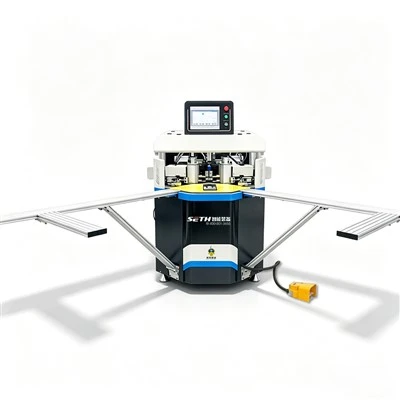
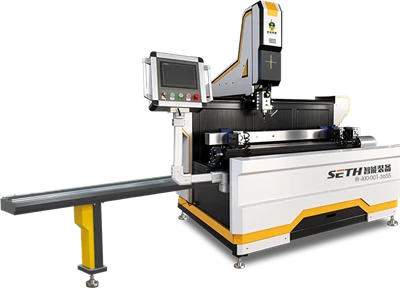


Aluminum door and window processing technology
How to create good doors, windows, and curtain walls?

Profile cutting
By using CNC sawing equipment, precise cutting at angles such as 45 ° and 90 ° can be achieved, ensuring cutting length accuracy (usually ≤ 0.1mm) and meeting the splicing requirements of door and window frames and sashes.
-When cutting, the cutting length should be automatically calculated by the CNC system based on the specifications of the profile and the size of the doors and windows. It should be matched with high-precision linear guides and imported saw blades to ensure a smooth and burr free cutting surface.
Milling and drilling of profiles
-Use CNC milling machine to process locking holes, slots, drainage holes, etc. on profiles. For example, the locking groove of a casement window and the pulley groove of a sliding window need to be precisely formed through milling technology to ensure that the hardware components function properly after installation.
-During the milling process, the program control of the CNC system is relied upon to ensure consistent machining dimensions and avoid hardware installation or door and window sealing failure caused by manual operation errors.


Corner crimping machining
-There are mainly two methods: corner squeezing and collision. Squeezing is the process of connecting corner codes and profiles through an angle squeezing machine; Collision angle is the use of a collision angle machine to combine corner codes with profiles under impact force.
-Before corner assembly, corner adhesive should be applied to the end of the profile to enhance the sealing and strength of the connection. The corners of the door and window frames should be flat and seamless to ensure overall structural stability.
Hardware installation
-Install corresponding hardware components such as hinges, handles, locks, pulleys, etc. according to the type of doors and windows (casement windows, sliding windows, inward facing windows, etc.).
-During installation, it is necessary to strictly follow the installation instructions of the hardware components to ensure their verticality and levelness, and to ensure smooth opening, closing, and locking functions of doors and windows.


Glass assembly
-First, install glass cushion blocks in the glass groove of the profile to ensure the horizontal position of the glass. Then, place the glass and install sealing strips or apply sealant (such as silicone glue).
-For insulated glass, it is necessary to ensure its central position in the groove, and the sealing strip or sealant should be continuous and without breaks to prevent rainwater leakage and air infiltration
Aluminum curtain wall processing technology
How to create good doors, windows, and curtain walls?

Profile processing
-Cutting: Use high-precision CNC cutting equipment to cut the curtain wall profiles to a fixed length, with higher cutting accuracy requirements (length accuracy ≤ 0.5mm) to ensure the splicing accuracy of the curtain wall panels.
-Milling grooves and drilling: The profiles are milled grooves (used for installing hangers, rubber strips, etc.) and drilled holes (used for connecting bolts, rivets, etc.) through a CNC machining center. The machining dimensions must strictly follow the curtain wall design drawings.
Plate assembly
-Keel assembly: Assemble the processed vertical and horizontal keels into a curtain wall keel frame through bolts or welding. During assembly, ensure the verticality and levelness of the keels, and control the error within the specified range.
-Panel installation: Install aluminum veneer (or other curtain wall panels) on the keel through hanging parts, bolts, and other connection methods. Aluminum veneer needs to undergo surface treatment (such as spraying, fluorocarbon spraying) before installation to enhance its weather resistance and decorative properties.
-Sealing treatment: Structural adhesive or sealing strips are used to seal between the panels. The structural adhesive needs to pass compatibility tests to ensure its bonding strength and sealing performance, preventing rainwater leakage and air infiltration.


Installation and connection of embedded parts
-Pre embedded parts: During the construction of the main structure of the building, the pre embedded parts of the curtain wall should be embedded in the concrete. The position and quantity of the pre embedded parts should meet the requirements of the curtain wall design to ensure the connection strength between the curtain wall and the main structure.
-Connection between keel and embedded parts: The curtain wall keel is connected to the embedded parts through an adapter, and the connecting bolts need to be tightened with anti loosening measures to ensure the overall stability of the curtain wall.
Glue injection and cleaning
-Glue injection: Apply glue evenly and fully to the gaps between curtain wall panels, with a smooth and even surface.
-Cleaning: After the glue injection is completed, clean the surface of the curtain wall to remove stains, glue marks, etc., ensuring the appearance quality of the curtain wall.
